Saturday, August 29, 2015

Jesus Christ: Superior and Divine

Jesus Christ is Greater than Angels
(Hebrews 1-2)


In the “Analysis of Hebrews,” under the “Epistle of Hebrews” in the Bible Dictionary, in numbers 1-5 we are told that Jesus Christ is superior to:
  • "Jesus is greater than the angels. He has a more excellent name, inheritance, and higher calling."
  • "Jesus is greater than Moses. Moses was a faithful servant, but Jesus was a faithful son."
  • Jesus’s word is superior to any. Jesus is greater than Moses, so we much obey the words of Jesus in order to enter the Lords kingdom.
  • "He is a high priest of Melchizedek, who is superior to the high priests of the Law of Moses."
In Hebrews 1 Paul described this superiority of Jesus Christ by stating these three truths of the Savior:
  • Jesus Christ is “better than the angels” because He is the Son of God (Hebrews 1:4).
  • He is the “heir of all things” (Hebrews 1:2).
  • He is the Creator of the worlds (Hebrews 1:2).


 “Christ condescended from His premortal throne and came to earth so that He could experience mortality with its physical restrictions” (Institute Manual, “A Little Lower than the Angles,” Hebrews 2:6-9). Even with this superiority and divinity our Savior came to earth to experience mortality, and witness the trials and temptations that plague us here on earth, so that He can better help us as we struggle with our individual trials and temptations. Although our Savior Jesus Christ did not fall into temptations or sin, He experienced all the struggles we each individually face. By doing this He is able to guide us, and strengthen us, and succor us. What wonderful, and loving Heavenly Father, and Savior we have, that they walked through this life before us, so that they can know how to help us to ensure our return to live with them.


Friday, August 28, 2015

Scriptures: Answers to our real life problems...


Find Solutions in the Scriptures to Life's Challenges
(Philippians 1-4)


The following are common challenges that we may face, and the counsel from scriptures in Philippians that could help resolve them:

People sometimes argue and complain over petty matters in church meetings or throughout the week.

In Philippians 2 verse 3 we are told, “let nothing be done through strife or vainglory; but in lowliness of mind let each esteem other better than themselves.” In verses 14-15 it says, “do all things without murmurings and disputings: That ye may be blameless and harmless, the sons of God, without rebuke, in the midst of a crooked and perverse nation, among who ye shine as lights in the world.” Paul basically counseled us to try and be selfless people always seeking to help and uplift those around us even when it is not convenient for us. He tells us not to complain and dispute, but to be willing to serve. Even as church members, we are not perfect, and we need to always remember to be patient, loving, and willing to work with others. We need to remember to work in unity for the greater good. 


Many youth feel that their parents’ testimony is sufficient for them. Since they have good parents, they rely on them for all their spiritual strength.

Although it is great for youth to rely on their parent’s testimony when they are struggling with their own, it is crucial that they work on obtaining and growing their own. In Philippians 2 verse 12 it states that we must “…work out [our] own salvation with fear and trembling.” In the old Institute Manual David O. McKay stated, “Work out your salvation is an exhortation to demonstrate by activity, by thoughtful, obedient effort the reality of faith. But this must be done with a consciousness that absolute dependence upon self may produce pride and weakness that will bring failure. With fear and trembling we should seek the strength and grace of God for inspiration to obtain the final victory” (“Work out Your Own Salvation with Fear and Trembling” [pp. 361–62]). By respectfully looking unto the Lord, and eagerly working to obtain our individual testimony, the Lord will spiritually strengthen us and bless us. It is great for each of us to know these things for ourselves, and to have this relationship with Heavenly Father. Overall, it is that spiritual knowledge we each have that we will be able to take with us to the next life.


An investigator is considering joining the Church, but his family will no longer associate with him if he does.

This scenario is definitely a difficult, and uncomfortable one to be in, especially for an investigator, but we are assured that any sacrifices we do for Christ’s sake won’t go unnoticed or unblessed. Paul endured and sacrificed so much to do the Lord’s will to which he says, “…I count all things but loss for the excellency of the knowledge of Christ Jesus my Lord: for whom I have suffered the loss of all things, and do count them but dung, that I may win Christ” (Philippians 3:8). Paul referred to the things he lost as “dung” to describe how insignificant or less valuable this things were compared to his relationship with Christ. Obviously, our families are not “dung,” and we shouldn’t think of them that way, but our relationships with Christ should be the most important and valuable one in our lives. We shouldn’t let anyone or anything get in the way of us creating and having a relationship with our Heavenly Father. If our families, can’t respect that then it is their loss. Heavenly Father knows the sacrifices we endure, and for them He will bless us. Our families can later see our examples, and our happiness and gravitate towards the gospel and Christ, or just respect us for standing up for what we believe in.


These real life situations are only a few examples of real life problems we may encounter. If we are ever in need of answers or solutions we can rely on scriptures to receive them. “Angels speak by the power of the Holy Ghost; wherefore, they speak the words of Christ. Wherefore, I said unto you, feast upon the words of Christ; for behold, the words of Christ will tell you all things what ye should do” (2 Nephi 32:3). Scriptures are the word of Christ, and through them we can know what to do in different situations. Let us gravitate towards them to receive answers and inspiration next time we need guidance, before gravitating anywhere else. The scriptures will give us the best-unbiased counsel.

Friday, August 21, 2015

"Be of good cheer"

 Paul’s Example of Courage and Conviction
(Acts 21-28)


After three successful missionary journeys that took him into many lands, Paul returned to Jerusalem to deliver the donations he had gathered for the poor, even though he knew it was dangerous to do so. In his journey to Jerusalem he encountered Agabus, a prophet who prophesied to him that he would be captured and bound if he continued to Jerusalem. Paul responded by saying that he was ready to face any adversity or any persecution if it were in the name of the Lord. He was even willing to give his life to follow the Spirit’s direction, and do the will of the Lord. Paul’s friends were concerned and initially tried to discourage him from going to Jerusalem, but realized his commitment to fulfill the Lord’s will and supported him (Acts 21:10-14, 22-25).

When Paul arrived in Jerusalem, he quickly noticed that many Jews were not so happy with his arrival. He learned that many people were unhappy with him because of rumors of Paul’s teachings against the Law of Moses, and circumcision practices. To demonstrate that these rumors were false, Church leaders encouraged Paul to participate in their temple rituals. Paul went unto the temple and participated in the weeklong purification rituals that Jews usually did after being around Gentiles. Some Jews from Asia spotted Paul during these rituals, and caused a scene, which caused Paul to be arrested. Paul was able to get himself some rights, and an opportunity to speak to the people. Paul shared his conversion story, which caused a commotion amongst the people, and caused him to be locked up and examined by the Sanhedrin. Following Paul’s examination by the Sanhedrin the Lord appeared to Paul and said “Be of good cheer, Paul: for as though has testified of me in Jerusalem, so must thou bear witness also at Rome” (Acts 23:11). The Lord basically told him not to fear, that he would live to bare his testimony in Rome.


While being detained, Paul finds out that there is a group of Jews that are planning to kill him. Paul is then transported to Caesarea and delivered to Roman governor Felix for trial. Paul learns of his charges, and answers in defense of his life and beliefs. He later bore his testimony of his faith in Jesus Christ to Felix and his wife. He talked about “righteousness, temperance, and judgment to come.” Felix wasn’t the most righteous person, so he probably trembled when he heard about the “judgments to come” (Acts 24:24-25). To try and bribe Paul for money in exchange for his release, Felix kept Paul in prison for two years. Acting in the same interest, governor Felix’s successor, Porcius Festus, proposed to send Paul back to Jerusalem. Paul objected to return to Jerusalem because he knew he would die, so instead asked to “appeal unto Caesar” (Acts 25:11). After discussing it with his council, he gave Paul the opportunity to be tried by Caesar in Rome.

Paul had the opportunity to bare his testimony once again to King Agrippa and his sister, while visiting Fetus. He taught them about the resurrection of Jesus Christ. Since Paul knew that King Agrippa was a Jew, he so craftily defended himself to try and get to him. King Agrippa said to Paul, “Almost thou persuadest me to be a Christian” (Acts 26:28), but chose not to follow the truth. Fetus, King Agrippa, and his sister were moved by Paul’s speech and found him not guilty of any crime and would have released him if it were not that he still need to be tried by Caesar (Acts 21:26-26:32).
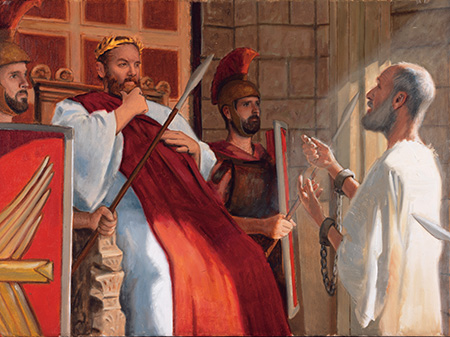

Paul continued to take many opportunities to teach and bless others because of his faith and courage. On his way to Caesar by boat, Paul prophesied a lot of “hurt and much damage” not only to the ship, but to the people on board (Acts 27:10). The centurion disregarded Paul’s counsel because he felt that the “master and the owner of the ship,” would know more about the weather conditions, and the boat than what Paul was saying (Acts 27: 11). When the master of the ship also rejected Paul’s counsel, Paul’s prophecy became true. Strong winds stirred up creating a terrible storm that tossed them “exceedingly” and damaged the ship (Acts 27:18). Everyone feared, but Paul told them to not fear. He knew that all passengers would arrive on land safely even thought the ship would be destroyed in the storm because an angel of the Lord stood by his side, and told him not be afraid because they would all arrive safely to Caesar (Acts 27:23-24). This prophecy was also fulfilled and they arrived in the island of Melita. There Paul was bitten by a poisonous snake, which had not effect on him due to the Priesthood power he possessed. He was not harmed “when he should have swollen, or fallen down dead suddenly” (Acts 28:6), which clearly proved that Paul was a man of God.

Finally they made their journey to Rome, where Paul continued to preach first to the Jews, and later the Gentiles. Paul wrote four epistles: Colossians, Ephesians, Philemon, and Philippians during his imprisonment to Rome. After his release, he continued to minister throughout other countries (Acts 27-28).

Through his difficult journey to Jerusalem, we can clearly see Paul’s courage and conviction. We can see how willing he was to put the Lord first regardless of what the consequences may be. He demonstrated great courage every time he would stand and defend himself before men men who could easily order to kill him. He would not be afraid to share his testimony every chance he got.

There are so many lessons we can learn from Paul’s examples of courage and conviction. Let us be as Paul, “of good cheer,” and remember to always be positive, faithful, and strong even during difficult times. Let us develop the type of courage Paul had by being truly converted into the gospel, educating ourselves by reading our scriptures, and by always having the Spirit with us, so that we can share the gospel at all times. We too can turn our trials into advantages if we are more spiritually minded people, and exercise our faith in Jesus Christ. Let us not be afraid to open our mouths and share the gospel with others. Not everyone will accept these truths for fear of change, but by sharing we are planting a seed.

I know it is easy to disregard the counsel that is given to us, especially those of our church leaders. We may think we know what’s best for us, but lets not be as the centurion and the master of the ship, and heed to promptings of the Spirit, and the guidance of our prophet and leaders. So that we may be prepared to be courageous and withstand adversity in the name of the Lord. -Amen

Thursday, August 20, 2015

“We die with Him, so we can live with Him”

Baptism 
(Romans 6)


“All those who humble themselves before God, and desire to be baptized, and come forth with broken hearts and contrite spirits, and witness before the church that they have truly repented of all their sins…shall be received by baptism into his church” (D&C 20:37).

In order to be baptized we must be willing to break away from sin by repenting and sin no more. In Romans 6:1-13, Paul reminded church members of the covenants they had made at baptism and explained to them that in choosing to sin they were not keeping with that baptismal covenant.

Paul explained the importance of baptism, and how it resembles the death, burial, and resurrection of Jesus Christ. As Elder L. Tom Perry stated, “The ordinance of baptism symbolizes Christ’s death and Resurrection—we die with Him so we can live with Him” (“The Gospel of Jesus Christ,” Ensign, May 2008, 46). Paul said that as we are “buried” with Christ by baptism we become dead to sin, and are “raised up from the dead” with “newness of life” in Christ (Romans 6:4).

For these reasons, we couldn’t be baptized by simply the sprinkling of water. By being completely immersed in water, we are leaving all our sins “buried,” or behind, and resurrecting as new people in Christ. Paul clearly described how baptisms were to be by his comparison to death, burial, and resurrection. By this manner, Jesus was also baptized.


These verses teach us that by choosing to be baptized we chose to put the “natural man” to rest in order to become righteous people in Christ. To maintain this “newness of life” in Christ, we are further told by Paul to repent, and not sin anymore. He reminds us that we became “free from sin,” when Jesus Christ paid for our sins through His Atonement (Romans 6:18).  Because we are His children, and His people, if we choose to continue to live without sin, and seek the righteous things in life we will receive “the gift of God [which] is eternal life through Jesus Christ our Lord” (Romans 6:23).


Friday, August 14, 2015

Lets forgive all!


“I, the Lord, will forgive whom I will forgive, but of you it is required to forgive all men” (D&C 64:10).


In the New Testament the people of Corinth were commanded to forgive, comfort, and love those who “have caused grief” against them (2 Corinthians 2: 5-8). Although it may be difficult to forgive those who hurt us, we are commanded to forgive all who have sin against us.

If we forgive not only will we have more peace in our hearts, but our sins will also be forgiven. “For if ye forgive men their trespasses, your heavenly Father will also forgive you” (Matthew 6:14). We will be blessed for forgiving our offenders, but we can also be punished for failing to forgive them. If we don’t forgive others then our sins won’t be forgiven, and we will be “condemned before the Lord,” and the “greater sin” will remain with us.

Forgiving others can be hard to do. We may be tempted to pick and choose whom we forgive and whom we hold a grudge against, but we must remember that we need to forgive everyone the same as the Lord forgives us, or else we are committing the bigger sin. Forgiving is part of being Christ-like people. I know that when I forgive I am happier and more at peace with myself, and I know that so is the Lord.


(2 Corinthians 2:1–11; Matthew 6:14–15; Doctrine and Covenants 64:9–10)